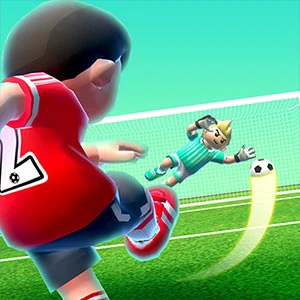
Chase the bounce with your body
Bouncy Dunks hands you a ball, a rim and a canvas you move across by touching and dragging. The on-screen prompt puts it plainly — touch and drag to move — and the ball keeps bouncing on its own, so your job is placing yourself under each arc before it comes back down.
Getting under the arc by touch and drag
Keep the ball bouncing and put it through the rim. A scored basket feeds straight into the next bounce rather than resetting the round, so the run is measured in how long you keep the ball alive and scoring.
Touch and drag to move, as the game's own prompt states, and tap to continue past the opening screen. The ball is not steered directly — you move yourself into position and let the bounce do the travelling.
Read one full bounce before moving anywhere. A single arc shows you how far the ball travels and where it will land, and that one observation is what turns the next drag into a deliberate move instead of a chase.
Move first, then let the ball arrive
The ball is never under your direct control, so the only way to influence a bounce is to be standing in the right place when it gets there. Drag into position early and the bounce meets you; drag too late and you are chasing an arc that has already passed.
Treat the opening prompt as a gate
The first screen shows a tap to continue prompt, and the round does not accept input before it appears. Waiting for that cue costs a second and prevents the confusion of dragging against a screen that is not listening yet.
Keep each drag short and deliberate
One clear drag repositions you for the arc you can already see. Stringing several small drags together while the ball is in the air moves you past the landing point and leaves you out of position for the very bounce you were setting up.
Judge the arc, not the current position
Where the ball is now matters far less than where it will be next. Watch the peak of the bounce — that is the moment the arc's destination becomes readable, and it is also the moment you should be finishing your drag.
Let a scored basket set your rhythm
Each basket rolls into the following bounce without a pause, so the natural playing rhythm comes from the scoring loop rather than from a countdown. Settle into that cadence and the run becomes a repeating sequence you can hold.
Where Bouncy Dunks sits on the shelf
Compared with the aiming titles nearby, this one removes the shot entirely and keeps only placement and timing: a moving canvas, a fixed arc, and a rim to be under at the right moment.
Reading the arc before you move
How do I control Bouncy Dunks?
Touch and drag to move. The ball bounces on its own, so you are repositioning yourself rather than steering the ball, and the on-screen prompt states the input directly the first time you play.
What happens when I score?
The ball carries straight on into the next bounce instead of the round restarting, which is what makes a scoring run feel continuous. Each basket essentially becomes the setup for the one after it.
Should I move while the ball is in the air?
Move at the peak of the bounce rather than mid-flight. That is the point where the landing spot is readable, so a drag begun there arrives in time, while one started as the ball descends is usually a step behind.
Why does the opening screen not respond to me?
Because it is waiting on its tap to continue prompt. Until that cue appears the screen is not accepting input, so let it show and then start dragging.